 |
das2C
das core C utilities (v3)
|
Loading...
Searching...
No Matches
|
das2C
das core C utilities (v3)
|
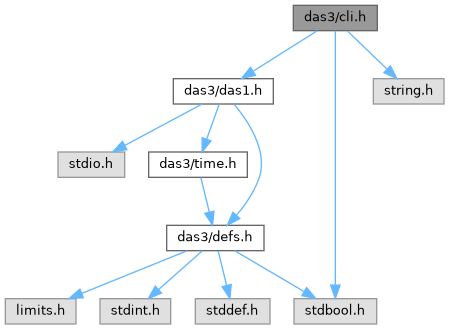
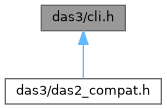
Go to the source code of this file.
Data Structures | |
| struct | DasSelector |
| Holds a single data selection query parameter. More... | |
| struct | DasOutput |
| A basic statement of output is needed to help with output resolution reduction. More... | |
Enumerations | |
| enum | das_selfmt |
| An enumeration of das selector value types. | |
Functions | |
| const char * | das_get_selstr (const DasSelector *pSels, const char *sKey, const char *sOp, const char *sDefault) |
| Get the a selection boundary as a raw string. | |
| int | das_get_selint (const DasSelector *pSels, const char *sKey, const char *sOp, int nDefault) |
| Get the selection boundary as an integer This function only works for INTEGER parameter types. | |
| bool | das_get_selbool (const DasSelector *pSels, const char *sKey, bool bDefault) |
| Get a selection criteria as a boolean Only works for BOOLEAN format selectors. | |
| double | das_get_selreal (const DasSelector *pSels, const char *sKey, const char *sOp, double rDefault) |
| Search for a selection criteria, return boundary value as a double. | |
| double | das_selreal (const DasSelector *pSel, const char *sOp, double rDefault) |
| Get a selection criteria from a particular selector as a double. | |
| void | das_get_seltime (const DasSelector *pSels, const char *sKey, const char *sOp, int *yr, int *mon, int *dom, int *doy, int *hr, int *min, double *sec) |
| Parse the boundary value into a time tuple. | |
| void | das_get_seldastime (const DasSelector *pSels, const char *sKey, const char *sOp, das_time *pDt) |
| Equivalent to das_get_seltime but uses the new das_time type from time.h. | |
| void | das_seldastime (const DasSelector *pSel, const char *sOp, das_time *pDt) |
| Equivalent to das_seltime but uses the new das_time type from time.h. | |
| const char * | das_get_selenum (const DasSelector *pSels, const char *sKey, const char *sDefault) |
| A short form of das_getstr for enumeration selectors. | |
| bool | das_get_outenabled (const DasOutput *pOuts, const char *sKey) |
| Search for the enabled status for a named output. | |
| bool | das_outenabled (const DasOutput *pOut) |
| Get the enabled status for a given output. | |
| double | das_get_outinterval (const DasOutput *pOuts, const char *sKey, double rDefault) |
| Search for the interval setting for a named output. | |
| double | das_outinterval (const DasOutput *pOut, double rDefault) |
| Get the interval setting for a given output. | |
| void | das_parsecmdline (int nArgs, char **sArgs, DasSelector *pSels, DasOutput *pOuts, const char *sDesc, const char *sFooter) |
| Parse a Das 2.3 style commandline, with Das 2.1 support. | |
| const char * | das_progname () |
| Get the program basename Only works after das_parsecmdline() has been called. | |
| int | das_loglevel () |
| Get the log level. | |
Note: It's time to make a new version of this library that uses functions to setup the selector and output arrays. They are getting complicated enough.
Nothing here is exported from das3.dll or libdas3.so, link libdas3.a (libdas3.lib on Windows) to use it.
| const char * das_get_selstr | ( | const DasSelector * | pSels, |
| const char * | sKey, | ||
| const char * | sOp, | ||
| const char * | sDefault | ||
| ) |
Get the a selection boundary as a raw string.
Since all values are stored internally as strings, this always works.
| pSels | the selector array |
| sKey | the selector key |
| sOp | the comparison operation string, one of ".ge.", .lt.", etc. |
| sDefault | a default value to return is this comparison criteria was not provided on the command line. |
| double das_get_selreal | ( | const DasSelector * | pSels, |
| const char * | sKey, | ||
| const char * | sOp, | ||
| double | rDefault | ||
| ) |
Search for a selection criteria, return boundary value as a double.
Only works for REAL format selectors
| void das_get_seltime | ( | const DasSelector * | pSels, |
| const char * | sKey, | ||
| const char * | sOp, | ||
| int * | yr, | ||
| int * | mon, | ||
| int * | dom, | ||
| int * | doy, | ||
| int * | hr, | ||
| int * | min, | ||
| double * | sec | ||
| ) |
Parse the boundary value into a time tuple.
NOTE: Argument doy can be null if you don't care about Day of Year
| const char * das_get_selenum | ( | const DasSelector * | pSels, |
| const char * | sKey, | ||
| const char * | sDefault | ||
| ) |
A short form of das_getstr for enumeration selectors.
Enumeration values are always strings, so das_getstr will wolk, this version of that function allows one to leave out the comparator argument.
| void das_parsecmdline | ( | int | nArgs, |
| char ** | sArgs, | ||
| DasSelector * | pSels, | ||
| DasOutput * | pOuts, | ||
| const char * | sDesc, | ||
| const char * | sFooter | ||
| ) |
Parse a Das 2.3 style commandline, with Das 2.1 support.
Keyword=value pair arguments are handled as directed by the selector set. There special arguments are also handled internally.
–das2times=SELECTOR This causes the first two non-special, non keyword.OP.value arguments to be treated as start_time and end_time. It also will search within the third argument to make sure it doesn't contain sub-arguments.
–das2int=OUTPUT This causes the third non-special, non keyword.OP.value argument to be treated as the sampling resolution. Using this requires the use of –das2times as well.
-h,–help Will print help text
-l LEVEL,–log=LEVEL This will set a global variable indicating which level details the reader should output when writing log messages to standard error. there is no facility for logging in this library this is just a standard way to indicate the caller's preference
Under normal operation the function exits with return value 15 with a message to standard error if there is a runtime problem. If there is a programming issue that should be fixed before release a message is still printed to standard error and 46 is returned.
| nArgs | - The number of argument character strings |
| sArgs | - The argument string pointer array |
| pSels | - A pointer to the first element of an array of data selectors These define the query parameters for this reader. |
| sDesc | - An optional chunk of text to output as the description part of the reader help. It may be NULL and is only used if '–help', '-h', or '-?' is detected on the commandline. |
| int das_loglevel | ( | ) |
Get the log level.
If -l or –log is not specified on the command line, or this function is called before das_parsecmdline() then the default log level is DAS2_LL_INFO.
 1.9.8