 |
das2C
das core C utilities (v3)
|
Loading...
Searching...
No Matches
|
das2C
das core C utilities (v3)
|
A frame-tagged geometric vector. More...
#include <das3/form.h>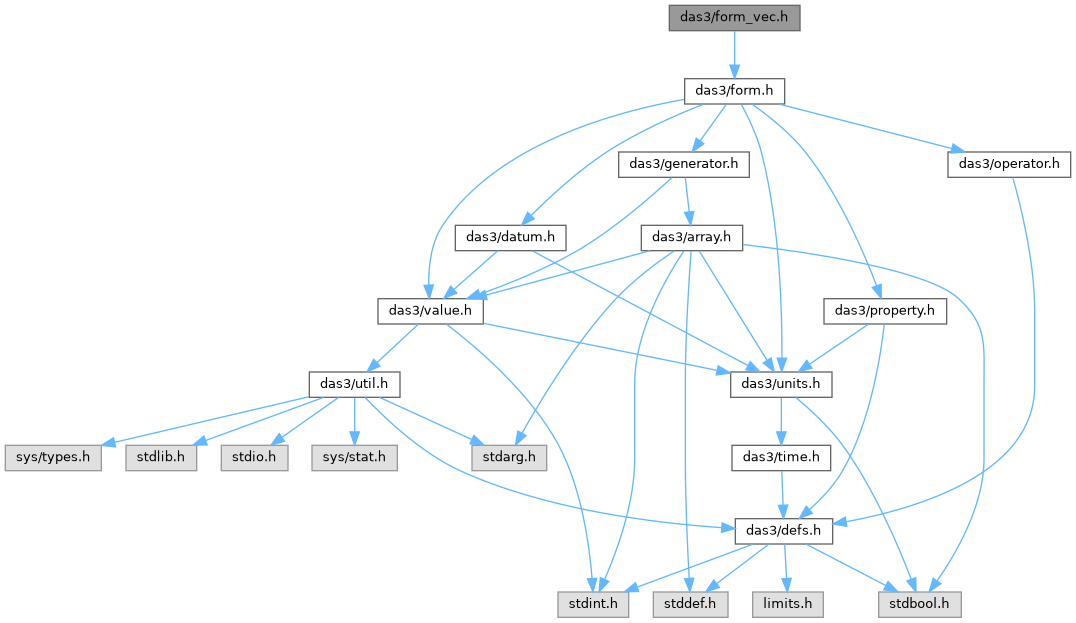
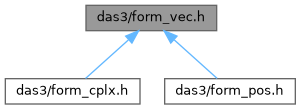
Go to the source code of this file.
Macros | |
| #define | das_vsys_isEllipsoidal(S) (((S) == DAS_VSYS_DETIC)||((S) == DAS_VSYS_GRAPHIC)) |
| Is this an ellipsoidal system, i.e. | |
| #define | DAS_FORM_VEC (&das_form_vector_vtbl) |
| A geometric vector in a reference frame. | |
Functions | |
| DAS_API const char * | das_vsys_toStr (ubyte uSys) |
| Wire token for any of the six system codes, NULL if unrecognized. | |
| DAS_API ubyte | das_vsys_fromStr (const char *sSys) |
| Wire token to system code across all six, DAS_VSYS_UNKNOWN if unrecognized. | |
| DAS_API const char * | das_vsys_desc (ubyte uSys) |
| One line of prose about any of the six, for a "notes" property. | |
| DAS_API const char * | das_vsys_symbol (ubyte uSys, int iDir) |
| The canonical symbol for direction iDir of a system: "x", "r", "λ", "h" ... | |
| DAS_API int8_t | das_vsys_index (ubyte uSys, const char *sSymbol) |
| The inverse of das_vsys_symbol(): which direction a symbol names. | |
| DAS_API const char * | das_vsys_name (ubyte uSys, int iDir) |
| The ASCII name for direction iDir of any of the six: "x", "rho", "theta", "lambda", "h" ... Handy when unicode symbols are a hazard. | |
| DAS_API int8_t | das_vsys_nameIndex (ubyte uSys, const char *sName) |
| The inverse of das_vsys_name(), also accepting the symbols, so both "theta" and the Greek letter give 1 for a spherical system. | |
| DAS_API double | das_vsys_default (ubyte uSys, int iDir) |
| The value an ABSENT component of this system defaults to. | |
| DAS_API bool | das_vsys_toCart (ubyte uSys, const double *pIn, double *pOut) |
| Convert one vector from a component system to cartesian. | |
| DAS_API bool | das_vsys_fromCart (ubyte uSys, const double *pIn, double *pOut) |
| Convert one cartesian vector to a component system. | |
A frame-tagged geometric vector.
NO origin.
A magnetic field, a velocity, a displacement: something with direction and magnitude that is not measured FROM anywhere. Free vectors add, subtract and scale, and one day will dot and cross.
Contrast form_pos.h, which is the same components with an ORIGIN and is therefore an affine point: positions subtract to give one of these, and two of them cannot be added at all. The discriminator is the origin, which is why they are two formalisms and not one with a flag.
surface= and body= aren't free vector concepts. A surface is a reference surface and for a position a body is the origin; a free vector has neither.
A frame that no kernel defines can still be described by a property; "frameInfo" is recommended for that purpose.
Parameters:
frame= the frame's NAME. OPTIONAL: a frameless vector is legal, it just cannot be frame-checked against anything. system= cartesian | cylindrical | spherical | centric. Default cartesian, which is what nearly all measured data is. sysorder= which canonical direction each stored component holds, e.g. "1;0;2". Default ascending.
ANGLES ARE ALWAYS DEGREES on the wire, so units carries whatever the radial component is in. The conversion helpers below take and return degrees for that reason.
| #define das_vsys_isEllipsoidal | ( | S | ) | (((S) == DAS_VSYS_DETIC)||((S) == DAS_VSYS_GRAPHIC)) |
Is this an ellipsoidal system, i.e.
one that requires a surface= ?
| #define DAS_FORM_VEC (&das_form_vector_vtbl) |
A geometric vector in a reference frame.
It has a direction and a magnitude but no starting point, so two of them add.
| DAS_API ubyte das_vsys_fromStr | ( | const char * | sSys | ) |
Wire token to system code across all six, DAS_VSYS_UNKNOWN if unrecognized.
It knows detic and graphic, so code building a free vector must still check the result against DAS_VSYS_VEC_MAX.
| DAS_API const char * das_vsys_desc | ( | ubyte | uSys | ) |
One line of prose about any of the six, for a "notes" property.
NULL if unrecognized.
| DAS_API const char * das_vsys_symbol | ( | ubyte | uSys, |
| int | iDir | ||
| ) |
The canonical symbol for direction iDir of a system: "x", "r", "λ", "h" ...
| DAS_API int8_t das_vsys_index | ( | ubyte | uSys, |
| const char * | sSymbol | ||
| ) |
The inverse of das_vsys_symbol(): which direction a symbol names.
| DAS_API const char * das_vsys_name | ( | ubyte | uSys, |
| int | iDir | ||
| ) |
The ASCII name for direction iDir of any of the six: "x", "rho", "theta", "lambda", "h" ... Handy when unicode symbols are a hazard.
| DAS_API int8_t das_vsys_nameIndex | ( | ubyte | uSys, |
| const char * | sName | ||
| ) |
The inverse of das_vsys_name(), also accepting the symbols, so both "theta" and the Greek letter give 1 for a spherical system.
| DAS_API double das_vsys_default | ( | ubyte | uSys, |
| int | iDir | ||
| ) |
The value an ABSENT component of this system defaults to.
Zero everywhere except a radius, which defaults to 1 IN THE VARIABLE'S UNITS. Units always describe the radial component, even an implied one, so an angles-only vector in degrees reads as a unit direction rather than a null vector, and an angles-only position in R_E lies on the reference sphere. Detic and graphic have no radius, so every slot of theirs is zero and a bare latitude and longitude lie on the reference surface.
| DAS_API bool das_vsys_toCart | ( | ubyte | uSys, |
| const double * | pIn, | ||
| double * | pOut | ||
| ) |
Convert one vector from a component system to cartesian.
| uSys | The system of the input values, one of DAS_VSYS_CART, DAS_VSYS_CYL, DAS_VSYS_SPH or DAS_VSYS_CENTRIC. |
| pIn | The three input components in CANONICAL direction order for uSys (see the DAS_VSYS_* definitions above), not storage order. Angles are in degrees. |
| pOut | Receives x, y, z in the same length units as the radial input component. May be the same array as pIn, to convert in place. |
| DAS_API bool das_vsys_fromCart | ( | ubyte | uSys, |
| const double * | pIn, | ||
| double * | pOut | ||
| ) |
Convert one cartesian vector to a component system.
The inverse of das_vsys_toCart().
| uSys | The system for the output values, one of DAS_VSYS_CART, DAS_VSYS_CYL, DAS_VSYS_SPH or DAS_VSYS_CENTRIC. |
| pIn | The input x, y, z values. |
| pOut | Receives the three components in CANONICAL direction order for uSys, angles in degrees. May be the same array as pIn, to convert in place. |
 1.9.8