 |
das2C
das core C utilities (v3)
|
Loading...
Searching...
No Matches
|
das2C
das core C utilities (v3)
|
Das Datasets. More...
#include <das3/dataset.h>
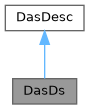
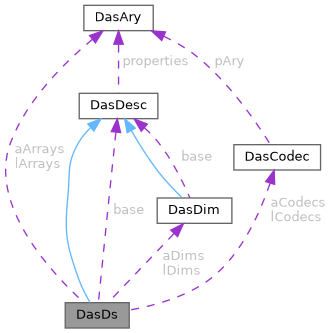
Public Member Functions | |
| DAS_API DasDs * | new_DasDs (const char *sId, const char *sGroupId, int nRank) |
| Create a new dataset object. | |
| DAS_API DasErrCode | DasDs_replaceAry (DasDs *pThis, const char *sOldId, DasAry *pNew) |
| Swap a storage array in a dataset for a replacement. | |
| DAS_API void | del_DasDs (DasDs *pThis) |
| Delete a Data object, cleaning up it's memory. | |
| DAS_API void | DasDs_setMutable (DasDs *pThis, bool bChangeAllowed) |
| Lock/Unlock the dataset for changes. | |
| #define | DasDs_mutable(P) P->_mutable |
| Get the lock state of the dataset. | |
| DAS_API int | DasDs_shape (const DasDs *pThis, ptrdiff_t *pShape) |
| Return current valid ranges for whole data set iteration. | |
| DAS_API ptrdiff_t | DasDs_lengthIn (const DasDs *pThis, int nIdx, ptrdiff_t *pLoc) |
| Return the current max value index value + 1 for any partial index. | |
| #define | DasDs_group(P) ((const char*)(P)->sGroupId) |
| Get the data set group id. | |
| #define | DasDs_id(P) ((const char*)(P)->sId) |
| Get the data set string id. | |
| #define | DasDs_getPlot(P) ((const char*)(P)->sPlot) |
| Get the plot type hint for a dataset. | |
| DAS_API DasErrCode | DasDs_setPlot (DasDs *pThis, const char *sPlot) |
| Set the plot type hint for a dataset. | |
| #define | DasDs_rank(P) ((P)->nRank) |
| Get the rank of a dataset. | |
| #define | DasDs_addAry(D, A) (DasDs_addAry((D), (A)) == DAS_OKAY) |
| Add an array to the dataset, stealing it's reference. | |
| #define | DasDs_numAry(P) ((P)->uArrays) |
| Get the number of arrays in the dataset. | |
| #define | DasDs_getAry(P, I) ((P)->lArrays[(I)]) |
| Get the a specific array in the dataset, buy index. | |
| DAS_API DasAry * | DasDs_getAryById (DasDs *pThis, const char *sAryId) |
| Get a dataset array given it's identifier. | |
| DAS_API size_t | DasDs_memUsed (const DasDs *pThis) |
| Get the currently used memory of all arrays in the dataset. | |
| DAS_API size_t | DasDs_memOwned (const DasDs *pThis) |
| Get the currently allocated memory of all arrays in the dataset. | |
| #define | DasDs_numCodecs(pThis) ( (pThis)->uCodecs ) |
| Number of value codecs owned by this dataset. | |
| #define | DasDs_getCodec(pThis, I) ( &( (pThis)->lCodecs[(I)] ) ) |
| Get the Ith codec of a dataset. | |
| DAS_API DasCodec * | DasDs_getCodecFor (const DasDs *pThis, const char *sAryId, int *pItems) |
| Get the codec for a named array. | |
| #define | DasDs_pktItems(P, I) ( (P)->lItems[(I)] ) |
| Get the number of values we expect the Ith codec to read from each raw packet buffer. | |
| DAS_API DasCodec * | DasDs_addFixedCodec (DasDs *pThis, const char *sAryId, const char *sSemantic, const char *sEncType, int nItemBytes, int nNumItems, bool bRead) |
| Define a packet data encoded/decoder for fixed length items and arrays. | |
| DAS_API DasCodec * | DasDs_addStringCodec (DasDs *pThis, const char *sAryId, const char *sSemantic, const char *sEncType, int nItemTerm, ubyte uTerm, int nNumItems, bool bRead) |
| Define a packet data encoder for a fixed number of variable length items in each packet. | |
| DAS_API DasCodec * | DasDs_addCodecFrom (DasDs *pThis, const char *sAryId, const DasCodec *pOther, int nNumItems, bool bRead) |
| Add a new codec that initialized via some other codec. | |
| DAS_API DasDs * | new_DasDs_xml (DasBuf *pBuf, DasDesc *pParent, int nPktId) |
| Parse a das3 <dataset> XML element into a new dataset object. | |
| DAS_API DasErrCode | DasDs_encodeHdr (DasDs *pThis, DasBuf *pBuf) |
| Encode the dataset header as a das3 <dataset> XML element. | |
| DAS_API DasErrCode | DasDs_decodeData (DasDs *pThis, DasBuf *pBuf) |
| Decode one packet's worth of data into dataset memory. | |
| DAS_API DasErrCode | DasDs_encodeData (DasDs *pThis, DasBuf *pBuf, ptrdiff_t iIdx0) |
| Encode one record's worth of data from dataset memory. | |
| DAS_API int | DasDs_recBytes (const DasDs *pThis) |
| Get the number of bytes in each record of this dataset when serialized. | |
| #define | DasDs_makeDim(D, T, S) DasDs_makeDim((D), (T), (S), NULL) |
| Make a new dimension within this dataset. | |
| DAS_API DasErrCode | DasDs_addDim (DasDs *pThis, DasDim *pDim) |
| Add a physical dimension to the dataset. | |
| DAS_API size_t | DasDs_numDims (const DasDs *pThis, enum dim_type dmt) |
| Get the number of physical dimensions in this dataset. | |
| #define | DasDs_getDim DasDs_getDimByIdx |
| Get a dimension by it's basic kind. | |
| DAS_API DasDim * | DasDs_getDimByIdx (DasDs *pThis, size_t idx, enum dim_type vt) |
| Get a dimension by index. | |
| DAS_API DasDim * | DasDs_getDimById (DasDs *pThis, const char *sId) |
| Get a dimension by string id. | |
| DAS_API int | DasDs_info (const DasDs *pThis, char *sBuf, size_t uLen) |
| Print a multi-line description of this dataset. | |
| #define | DasDs_toStr(P, B, N) (DasDs_info((P), (B), (size_t)(N)), (B)) |
| Print a one line summary of this dataset. | |
| DAS_API DasDs * | new_DasDs_packet (DasStream *pSd, PktDesc *pPd, const char *sGroup, bool bCodecs) |
| Up-convert a das2 packet descriptor into a new dataset object. | |
| #define | DasDesc_type(P) ((P)->type) |
| Get the type of this descriptor. | |
| DAS_API void | DasDesc_init (DasDesc *pThis, desc_type_t type) |
| Initialize a memory location as a valid das descriptor. | |
| DAS_API int | DasDesc_info (const DasDesc *pThis, char *sBuf, size_t uLen, const char *sIndent) |
| Print 1-line versions of each property in a descriptor. | |
| DAS_API void | DasDesc_freeProps (DasDesc *pThis) |
| For use in derived destructors, frees the property array. | |
| DAS_API void | DasDesc_clearProps (DasDesc *pThis) |
| Resets the property count to 0, but frees no memory. | |
| DAS_API bool | DasDesc_equals (const DasDesc *pThis, const DasDesc *pOther) |
| Check to see if two descriptors contain the same properties Note, the order of the properties may be different between the descriptors but if the contents are the same then the descriptors are considered to be equal. | |
| DAS_API const DasDesc * | DasDesc_parent (const DasDesc *pThis) |
| The the parent of a Descriptor. | |
| DAS_API size_t | DasDesc_length (const DasDesc *pThis) |
| Get the number of properties in a descriptor. | |
| DAS_API const DasProp * | DasDesc_getPropByIdx (const DasDesc *pThis, size_t uIdx) |
| Get a property name by an index. | |
| DAS_API const char * | DasDesc_getNameByIdx (const DasDesc *pThis, size_t uIdx) |
| Get a property name by an index. | |
| DAS_API const char * | DasDesc_getValByIdx (const DasDesc *pThis, size_t uIdx) |
| Get a property value by an index. | |
| DAS_API const char * | DasDesc_getTypeByIdx (const DasDesc *pThis, size_t uIdx) |
| Get a data type of a property by an index. | |
| DAS_API const char * | DasDesc_getTypeByIdx3 (const DasDesc *pThis, size_t uIdx) |
| Get a data type of a property by an index, das3 convention. | |
| DAS_API DasErrCode | DasDesc_set (DasDesc *pThis, const char *sType, const char *sName, const char *sVal) |
| Generic property setter. | |
| DAS_API DasErrCode | DasDesc_flexSet (DasDesc *pThis, const char *sType, ubyte uType, const char *sName, const char *sVal, char cSep, das_units units, int nStandard) |
| Create or set a existing property. | |
| DAS_API DasErrCode | DasDesc_setProp (DasDesc *pThis, const DasProp *pProp) |
| Overwrite, or copy-in a fully formatted property. | |
| DAS_API const char * | DasDesc_getType (const DasDesc *pThis, const char *sName) |
| Get the type string for a property. | |
| DAS_API das_units | DasDesc_getUnits (const DasDesc *pThis, const char *sName) |
| Get the units of a property. | |
| DAS_API const char * | DasDesc_get (const DasDesc *pThis, const char *sName) |
| Get a raw property string. | |
| DAS_API bool | DasDesc_has (const DasDesc *pThis, const char *sName) |
| Determine if a property is present in a Descriptor or it's ancestors. | |
| DAS_API bool | DasDesc_hasLocal (const DasDesc *pThis, const char *sName) |
| Does this descriptor alone have this property. | |
| DAS_API bool | DasDesc_remove (DasDesc *pThis, const char *sName) |
| Remove a property from a descriptor, if preset. | |
| DAS_API const char * | DasDesc_getStr (const DasDesc *pThis, const char *sName) |
| read the property of type String named sName. | |
| DAS_API size_t | DasDesc_getStrAry (DasDesc *pThis, const char *sName, char *pBuf, size_t uBufSz, char **psVals, size_t uMaxVals) |
| Get a multi-valued string property. | |
| DAS_API DasErrCode | DasDesc_setStr (DasDesc *pThis, const char *sName, const char *sVal) |
| SetProperty methods add properties to any Descriptor (stream,packet,plane). | |
| DAS_API DasErrCode | DasDesc_vSetStr (DasDesc *pThis, const char *sName, const char *sFmt,...) |
| Set a string property in the manner of sprintf. | |
| DAS_API double | DasDesc_getDouble (const DasDesc *pThis, const char *sName) |
| Read the property of type double named sName. | |
| DAS_API DasErrCode | DasDesc_setDouble (DasDesc *pThis, const char *sName, double value) |
| Set property of type double. | |
| DAS_API double | DasDesc_getDatum (DasDesc *pThis, const char *sName, das_units units) |
| Get the a numeric property in the specified units. | |
| DAS_API DasErrCode | DasDesc_setDatum (DasDesc *pThis, const char *sName, double rVal, das_units units) |
| Set property of type Datum (double, UnitType pair) | |
| DAS_API double * | DasDesc_getDoubleAry (DasDesc *pThis, const char *sName, int *pNumItems) |
| Get the values of an array property. | |
| DAS_API DasErrCode | DasDesc_setDoubleArray (DasDesc *pThis, const char *sName, int nItems, double *pValues) |
| Set the property of type double array. | |
| DAS_API int | DasDesc_getInt (const DasDesc *pThis, const char *sName) |
| Get a property integer value. | |
| DAS_API DasErrCode | DasDesc_setInt (DasDesc *pThis, const char *sName, int nVal) |
| Set the property of type int. | |
| DAS_API bool | DasDesc_getBool (DasDesc *pThis, const char *sName) |
| Get a property boolean value. | |
| DAS_API DasErrCode | DasDesc_setDatumRng (DasDesc *pThis, const char *sName, double beg, double end, das_units units) |
| Set property of type DatumRange (double, double, UnitType triple) | |
| DAS_API DasErrCode | DasDesc_getStrRng (DasDesc *pThis, const char *sName, char *sMin, char *sMax, das_units *pUnits, size_t uLen) |
| Get a property of type DatumRange with unconverted strings. | |
| DAS_API DasErrCode | DasDesc_setFloatAry (DasDesc *pThis, const char *sName, int nItems, float *pValues) |
| Set the property of type float array. | |
| DAS_API void | DasDesc_copyIn (DasDesc *pThis, const DasDesc *pOther) |
| Deepcopy properties into a descriptor. | |
| DAS_API DasErrCode | DasDesc_encode2 (DasDesc *pThis, DasBuf *pBuf, const char *sIndent) |
| Encode a generic set of properties to a buffer. | |
| DAS_API DasErrCode | DasDesc_encode3Bare (DasDesc *pThis, DasBuf *pBuf, const char *sIndent) |
| Encode das3 properties WITHOUT the enclosing properties element. | |
| DAS_API bool | DasDesc_hasAnyProps (const DasDesc *pThis) |
| Does this descriptor hold at least one valid property? | |
Data Fields | |
| void * | pUser |
| User data pointer. | |
Das Datasets.
Das Datasets provide storage for arrays that contains both data values and coordinate values. Each dataset corresponds to a single index space. All variables in the dataset support the same bulk index range, though they may not produce unique values for each distinct set of indices.
Mapping from the dataset index space to individual arrays is handled by variables (::DasVar).
Variables are grouped together into physical dimension by das2 dimension (DasDim) objects. Each variable in a dimension servers a role. For example providing center point values. Bin max values, bin min, uncertainty, etc.
A typical dataset consisting of a Time dimension, Frequency dimension and Amplitude dimension may have the following index ranges:
Here i is the first index and j is the second.
The first two dimensions define a time and frequency coordinates space, and the last provides amplitude values collected at over time and frequency.
Binning these values could proceed in a loops such as described in the the ::DasDs_lengthLast function.
| DAS_API DasDs * new_DasDs | ( | const char * | sId, |
| const char * | sGroupId, | ||
| int | nRank | ||
| ) |
Create a new dataset object.
| sId | An identifier for this dataset. (group, id) is the dataset's key: it must be unique within a stream, over the life of the stream, not only among currently defined datasets. |
| sGroupId | An identifier for the group to which the dataset belongs, or NULL for the null group. Datasets in a group are meant to be plotted together, though their index shapes need not match in any respect. The null group is a namespace only; its members are not joined with each other. |
Grouping rule: one member of a group must have every physical dimension (coordinate or data) that appears anywhere in the group; the others may have fewer. Thus a (time, frequency) line may join a (time, frequency, E) spectrogram, but a (time, frequency, B) dataset may not join the with the E spectrogram. Units of a shared physical dimension should be inter-convertible.
| nRank | The overall iteration rank for the dataset, i.e. the number of indices needed to retrieve values from this dataset's variables. ALL variables in a dateset accept the same number of indices in the same relative positions when reading values. |
Unlike ISTP CDF's, rank is an iteration property and has no defined relationship to the number of physical dimensions of the dataset. Thus two datasets may have different ranks but be part of the same group.
| DAS_API DasErrCode DasDs_replaceAry | ( | DasDs * | pThis, |
| const char * | sOldId, | ||
| DasAry * | pNew | ||
| ) |
Swap a storage array in a dataset for a replacement.
Finds the array registered under sOldId, re-points every array variable that reads from it at pNew (via DasVarAry_setArray, so the variables pick up the new array's value type, units and semantic), and swaps the dataset's array-list entry, fixing the reference counts so the old array is released once nothing else in this dataset holds it.
This is the companion to DasDs_copy() for stream filters that must change a value type rather than just an encoding. The motivating case is a binary -> text re-encoder that turns an epoch integer/real array into a das_time array so the codec can write ISO-8601: build the das_time array, then call this to splice it in. The replacement must have the same rank as the array it replaces.
| pThis | The dataset to modify. |
| sOldId | The id of the array to retire. |
| pNew | The replacement array, same rank as the retired one. The dataset takes a reference; the caller keeps its own and may drop it afterward. |
| DAS_API void del_DasDs | ( | DasDs * | pThis | ) |
Delete a Data object, cleaning up it's memory.
If the underlying arrays and property values are needed else where call release on sub items.
| pThis | The dataset object to delete, provided pointer should be set to NULL after this operation. |
| DAS_API void DasDs_setMutable | ( | DasDs * | pThis, |
| bool | bChangeAllowed | ||
| ) |
Lock/Unlock the dataset for changes.
All DasDs object default to mutable. This has the side effect that certain values which could be cached for speed (such as the shape) must be re-calculated on demand. Use this function to lock the dataset from being changed so that it can cache frequent requests.
| pThis | The dataset in question |
| bChangeAllowed | if false, the shape of the data set will be cached and all calls that would alter the dataset will fail. Note that it is possible to change a dataset in an external manner that is not visible using the DasDim_, DasVar_ and DasAry_ functions directly. |
| DAS_API int DasDs_shape | ( | const DasDs * | pThis, |
| ptrdiff_t * | pShape | ||
| ) |
Return current valid ranges for whole data set iteration.
To plot all values in a dataset iterate over the entire range provided for each function. The returned shape is the maximum value + 1 of each index of the given dataset. The shape can change as data are added to the dataset.
Data variables that include point spread functions and variables that provide vectors require an inner iteration that is not part of the returned shape.
Note that for a properly defined dataset all indices below the rank of the dataset will be used.
| pThis | A pointer to a dataset object | |
| [out] | pShape | pointer to an array to receive the current bulk iteration shape required to get all the values from all variables in the dataset. |
| DAS_API ptrdiff_t DasDs_lengthIn | ( | const DasDs * | pThis, |
| int | nIdx, | ||
| ptrdiff_t * | pLoc | ||
| ) |
Return the current max value index value + 1 for any partial index.
This is a more general version of DasDim_shape that works for both cubic arrays and with ragged dimensions, or sequence values.
| pThis | A pointer to a DasDim structure |
| nIdx | The number of location indices which may be less than the number needed to specify an exact value. |
| pLoc | A list of values for the previous indexes, must be a value greater than or equal to 0 |
| DAS_API DasErrCode DasDs_setPlot | ( | DasDs * | pThis, |
| const char * | sPlot | ||
| ) |
Set the plot type hint for a dataset.
| pThis | A pointer to a dataset structure |
| sPlot | One of the values listed at DasDs_getPlot(), or NULL or "" to clear the hint |
Get a dataset array given it's identifier.
Every array must have a text ID, furthermore these must be unique within the dataset (enforced by DasDs_addAry).
| pThis | a dataset structure pointer |
| sId | A text string identifying one of the datasets arrays |
| DAS_API size_t DasDs_memUsed | ( | const DasDs * | pThis | ) |
Get the currently used memory of all arrays in the dataset.
Note that this is not the memory footprint, as DasAry's will allocate more space then needed during append operations. This is done to reduce the number of allocations.
| pThis | a dataset structure pointer |
| DAS_API size_t DasDs_memOwned | ( | const DasDs * | pThis | ) |
Get the currently allocated memory of all arrays in the dataset.
| pThis | a dataset structure pointer |
Get the codec for a named array.
| pThis | A dataset owning both codecs and arrays |
| sAryId | The string ID of the array for which a codec is needed. |
| pItems | A pointer to a single int to hold the number of items serialized at a time using this codec (the schema's numItems) |
| DAS_API DasCodec * DasDs_addFixedCodec | ( | DasDs * | pThis, |
| const char * | sAryId, | ||
| const char * | sSemantic, | ||
| const char * | sEncType, | ||
| int | nItemBytes, | ||
| int | nNumItems, | ||
| bool | bRead | ||
| ) |
Define a packet data encoded/decoder for fixed length items and arrays.
| pThis | a Dataset structure pointer |
| sAryId | The array to encode to/decode from |
| sSemantic | How the values are to be used. This affects parsing. For example a string meant to represent a datatime is stored differently from one that represents an annotation. Semantics are especially important for data encoded as text. Use one of the following: |
| sEncType | one of the following encoding types as taken from the das-basic-stream-v3.0.xsd schema: |
| nItemBytes | The fixed number of bytes in an item. Variable size item flags not supported. |
| nNumItems | The number of items to read/write at a time. |
| bRead | If true initialize a decoder, if false initialize an encoder. For readability the macros DASENC_READ and DASENC_WRITE can be used |
| DAS_API DasCodec * DasDs_addStringCodec | ( | DasDs * | pThis, |
| const char * | sAryId, | ||
| const char * | sSemantic, | ||
| const char * | sEncType, | ||
| int | nItemTerm, | ||
| ubyte | uTerm, | ||
| int | nNumItems, | ||
| bool | bRead | ||
| ) |
Define a packet data encoder for a fixed number of variable length items in each packet.
Despite the name, strings are just a run of bytes. These bytes need not be valid utf8 encoding units. With the use of DASENC_ITEM_LEN, random blobs of arbitrary bytes can be read.
| pThis |
| sAryId |
| sEncType |
| nItemTerm | Since a variable number of bytes can be use, provide the size determination. Either DASENC_ITEM_TERM to indicate that items terminate when a special byte is read, or DASENC_ITEM_LEN to indicate that explicit lengths are provided inside the packets themselves. |
| nSeps | The number of separators for variable length items. For text items, item separator is first. Next are the separators that indicate the end of fastest moving dataset index, followed by the end of the next fastest an so on. The max number of separators must equal to the rank of the array they encode. Each separator is only 1 byte long. If this is not sufficient you'll have to go with DASENC_ITEM_LEN |
| uSepLen | The length in bytes of the variable length separators. Must be a value from 1 through 8, inclusive. |
| pSepByIdx | Pointer to an array of separator bytes. This must be nSeps * uSepLen long. |
| bRead | If true initialize a decoder, if false initialize an encoder. For readability the macros DASENC_READ and DASENC_WRITE can be used |
| DAS_API DasCodec * DasDs_addCodecFrom | ( | DasDs * | pThis, |
| const char * | sAryId, | ||
| const DasCodec * | pOther, | ||
| int | nNumItems, | ||
| bool | bRead | ||
| ) |
Add a new codec that initialized via some other codec.
Before calling this function make sure the array ID expected of the codec is present in the current dataset, or use sAryId.
| pThis | The dataset that should create an new internal codec. |
| pOther | The other codec whose values are used to initialize our new codec for this dataset. |
| sAryId | If not NULL, override the array ID in the old codec when creating the new one. An array with this ID should already exist in this dataset. |
| nNumItems | The number of items to read/write at a time. |
| bRead | If true initialize a decoder, if false initialize an encoder. For readability the macros DASENC_READ and DASENC_WRITE can be used |
Parse a das3 <dataset> XML element into a new dataset object.
Builds the complete object – dimensions, variables, backing arrays and read codecs – from a header the buffer holds. The write mirror is DasDs_encodeHdr(). When the buffer's content type isn't known in advance (any of the five stream elements), use the generic factory DasDesc_decode() in stream.h instead, which dispatches here for dataset headers.
Only the XML element is read; the caller owns the packet tag and should not send it here. Set the read point of the buffer after the packet tag first.
| pBuf | the buffer to parse, starting from its current read point |
| pParent | the stream this dataset belongs to (frames resolve there) |
| nPktId | the packet tag ID assigned to this dataset |
| DAS_API DasErrCode DasDs_encodeHdr | ( | DasDs * | pThis, |
| DasBuf * | pBuf | ||
| ) |
Encode the dataset header as a das3 <dataset> XML element.
Writes the complete declaration – name, rank, index= extents from the live shape, properties, and every dimension, variable and <packet> child. The <packet> elements reflect the CODECS' current state, so configure write codecs before calling. Marks the dataset's header as sent.
Only the element is written; the caller owns the |Hx| packet framing. The read mirror is new_DasDs_xml(); the payload siblings are DasDs_decodeData() and DasDs_encodeData().
| pThis | the dataset to describe |
| pBuf | the output receiver |
| DAS_API DasErrCode DasDs_decodeData | ( | DasDs * | pThis, |
| DasBuf * | pBuf | ||
| ) |
Decode one packet's worth of data into dataset memory.
Uses the dataset's read codecs, in order, to parse the buffer contents into the backing arrays, closing ragged runs (DasAry_markEnd) as needed. The buffer's read point is advanced past the consumed bytes.
This is the bare payload layer: the caller (typically the das IO layer) supplies one packet's content with the |Pd| framing already stripped.
| pThis | a dataset with decoders defined, see new_DasDs_xml() |
| pBuf | the buffer to read, starting from its current read point |
| DAS_API DasErrCode DasDs_encodeData | ( | DasDs * | pThis, |
| DasBuf * | pBuf, | ||
| ptrdiff_t | iIdx0 | ||
| ) |
Encode one record's worth of data from dataset memory.
The write mirror of DasDs_decodeData: runs the dataset's write codecs, in order, over one increment of the record (highest) index, emitting each variable-count run with its framing: "[idx|N]" count tags for non-text (in every packet position), idxTerm terminators for utf8.
Only the payload is written; the caller owns the |Pd| packet framing. Call in a loop over the record index to serialize a whole dataset.
| pThis | a dataset with encoders defined |
| pBuf | the output receiver |
| iIdx0 | the record index value to emit |
| DAS_API int DasDs_recBytes | ( | const DasDs * | pThis | ) |
Get the number of bytes in each record of this dataset when serialized.
Given the current codec set, determine how many bytes must be read for each packet in a stream. Works for the fixed encodings typical in *.d3b and *.d3t files but not for serializing to and from pure XML documents.
| pThis | a Dataset structure pointer |
| DAS_API DasErrCode DasDs_addDim | ( | DasDs * | pThis, |
| DasDim * | pDim | ||
| ) |
Add a physical dimension to the dataset.
| pThis | A pointer to a dataset structure |
| pDim | A existing dimension object created on the heap. |
| DAS_API size_t DasDs_numDims | ( | const DasDs * | pThis, |
| enum dim_type | dmt | ||
| ) |
Get the number of physical dimensions in this dataset.
| pThis | The dataset object |
| vt | The variable type, either COOR or DATA |
Get a dimension by index.
| pThis | a pointer to a dataset structure |
| idx | the index of the variable in question |
| vt | the variable type, either COORD or DATA |
Get a dimension by string id.
| pThis | a pointer to a dataset structure |
| sId | The name of the dimension to retrieve, for example 'time' or 'frequency'. The name is not case sensitive |
| DAS_API int DasDs_info | ( | const DasDs * | pThis, |
| char * | sBuf, | ||
| size_t | uLen | ||
| ) |
Print a multi-line description of this dataset.
A multi-line summary of the dataset, its properties, and each dimension with its variables. Large sets of housekeeping variables can run to tens of kilobytes, so size the buffer from a first call:
| pThis | The dataset to describe. |
| sBuf | The output buffer, may be NULL if uLen is 0. |
| uLen | The size of sBuf in bytes, including room for the terminating NUL. Output that does not fit is cut off, but sBuf is always NUL terminated when uLen > 0 and nothing past sBuf[uLen-1] is touched. |
| DAS_API DasDs * new_DasDs_packet | ( | DasStream * | pSd, |
| PktDesc * | pPd, | ||
| const char * | sGroup, | ||
| bool | bCodecs | ||
| ) |
Up-convert a das2 packet descriptor into a new dataset object.
This is the factory DasDesc_decode() uses for das2 <packet> headers when reading into the das3 model. It is public so a filter that reads in the das2 model, to select on packet IDs and plane names, can still get the standard das3 rendering of each packet and alter it before writing.
The layout follows the das2 plane pattern: X-Y, X-Y-Z, X-YScan or events. Each plane becomes one storage array, one variable and, unless planes share a "source" property, one dimension named for the plane. Plane properties are copied to their dimensions with the das2 axis prefix stripped. A das2 text time plane's units name an epoch, but that is a conversion hint for das2java, not the wire units; such planes render as calendar values.
| pSd | the stream the packet belongs to. Needed because a das2 waveform layout is announced in the stream header, not the packet. |
| pPd | the packet descriptor to inspect. It is not changed and is not retained, so the caller may delete it afterward. |
| sGroup | the group, which is the wire name, for the new dataset. NULL takes the packet's group property, or the lone Y plane's name, or a made up name when neither exists. |
| bCodecs | true to define codecs matching the packet's encodings so the dataset can parse payloads as sent, or emit its header with the same <packet> layout. False attaches arrays of doubles with no codecs, which suits values arriving pre-parsed through PlaneDesc. |
|
inherited |
Initialize a memory location as a valid das descriptor.
The whole DasDesc is zeroed first, so stack or reused memory is fine. It is not freed: call DasDesc_freeProps() before re-initializing a descriptor that already holds properties.
|
inherited |
Print 1-line versions of each property in a descriptor.
Values longer than 48 bytes are clipped and end in "...". Same calling convention as DasDs_info(), so the containers can nest it.
| pThis | The descriptor whose properties are printed. |
| sBuf | The output buffer, may be NULL if uLen is 0. |
| uLen | The size of sBuf in bytes, including room for the terminating NUL. Output that does not fit is cut off, but sBuf is always NUL terminated when uLen > 0 and nothing past sBuf[uLen-1] is touched. |
| sIndent | Prefix for each line, for nesting under a container. |
|
inherited |
For use in derived destructors, frees the property array.
After calling this function, no new properties can be added
|
inherited |
Resets the property count to 0, but frees no memory.
Call this to re-use a descriptor.
Check to see if two descriptors contain the same properties Note, the order of the properties may be different between the descriptors but if the contents are the same then the descriptors are considered to be equal.
Note that parent descriptor properties are not checked when handling the comparison.
| pThis | The first descriptor |
| pOther | The second descriptor |
The the parent of a Descriptor.
Plane descriptors are owned by packet descriptors and packet descriptors are owned by stream descriptors. This function lets you craw the ownership hierarchy
| pThis |
|
inherited |
Get the number of properties in a descriptor.
Descriptor's have a hierarchy. In general when a property is requested, if a given Descriptor does not have a property the request is passed to the parent descriptor. This function only returns the number of properties in the given descriptor. It does not include properties owned by parents or ancestors.
This is useful when iterating over all properties in a descriptor.
| pThis | A pointer to the descriptor to query |
Get a property name by an index.
This is useful when iterating over all properties in a Descriptor. Only valid properties owed by a descriptor are queried in this manner. Parent descriptors are not consulted.
| pThis | A pointer to the descriptor to query |
| uIdx | The index of the property, will be a value between 0 and the return value from Desc_length(). For efficient storage properties that have been erased or over-written are left in place internally and just marked as invalid. |
|
inherited |
Get a property name by an index.
This is useful when iterating over all properties in a Descriptor. Only properties owed by a descriptor are queried in this manner. Parent descriptors are not consulted.
| pThis | A pointer to the descriptor to query |
| uIdx | The index of the property, will be a value between 0 and the return value from Desc_length() |
|
inherited |
Get a property value by an index.
This is useful when iterating over all properties in a Descriptor. Only properties owned by a descriptor are queried in this manner. Parent descriptors are not consulted.
| pThis | A pointer to the descriptor to query |
| uIdx | The number of the property, will be a value from 0 and 1 less than the return value from Desc_length() |
|
inherited |
Generic property setter.
All properties are stored internally as strings. The various typed Desc_setProp* functions all call this function after converting their arguments to strings.
| pThis | The Descriptor to receive the property |
| sType | The Type of property. This value is passed down to DasProp_init2(), see that function for a list of known values. |
| sName | The property name. For das2 & das3 this can't contain spaces. |
| sVal | The value, which may be anything including NULL |
|
inherited |
Create or set a existing property.
Other then memory handling, this is just a wrapper on DasProp_init. See @DasProp_init for the argument description
|
inherited |
Overwrite, or copy-in a fully formatted property.
|
inherited |
Get the type string for a property.
Get the units of a property.
|
inherited |
Get a raw property string.
This function performs no transforms from the backing store.
|
inherited |
Determine if a property is present in a Descriptor or it's ancestors.
| pThis | the descriptor object to query |
| sName | the name of the property to retrieve. |
|
inherited |
Does this descriptor alone have this property.
The question does not cascade up the tree
|
inherited |
Remove a property from a descriptor, if preset.
It is safe to call this function for properties not present on the descriptor, it simply does nothing and returns false.
|
inherited |
Get a multi-valued string property.
Some properties, especially those from DSDF files, contain multiple string values in a single field separated by pipe "|" characters. For example:
data_01 = 'efield | Electric field intensity | V m**-1'
This function breaks these values into multiple strings without requiring heap memory.
Output bytes are copied into the given val_buf. Then null values are then written over all leading and trailing whitespace for each element as well as the pipe characters.
Finally a pointer to each starting string is copied into ptr_buf. If an element contains not data, for example:
coord_01 = 'frequency | | Hz'
then the corresponding character pointer will be NULL, but the number of character pointers is unchanged.
| [in] | pThis | the descriptor to query |
| [in] | name | the name of the property to retrieve |
| [out] | val_buf | will hold the full output property data |
| [in] | val_buf_sz | the maximum number of bytes to copy out including the terminating null character. |
| [out] | ptr_buf | will hold pointers to the start of each property value. If a value is empty, the corresponding pointer is null. |
| [in] | ptr_buf_sz | the maximum number of string pointers write to ptr_buf. |
|
inherited |
SetProperty methods add properties to any Descriptor (stream,packet,plane).
The typed methods (e.g. setPropertyDatum) property tag the property with a type so that it will be parsed into the given type.
|
inherited |
Read the property of type double named sName.
The property value is parsed using sscanf.
|
inherited |
Set property of type double.
Get the a numeric property in the specified units.
Descriptor properties my be provided as Datums. Datums are a double value along with a specified measurement unit.
| pThis | The Descriptor containing the property in question. |
| sName | The name of the property to retrieve. |
| units | The units of measure in which the return value will be represented. If the property value is stored in a different set of units than those indicated by this parameter than the output will be converted to the given unit type. |
|
inherited |
Set property of type Datum (double, UnitType pair)
If a property with this name already exists it is 1st deleted and then the new property is added in its place.
| pThis | The descriptor to receive the property |
| sName | The name of the property to set |
| rVal | The numeric value of the property |
| units | The units of measure for the property |
|
inherited |
Get the values of an array property.
Space for the array is allocated by getDoubleArrayFromString. and nitems is set to indicate the size of the array.
| [in] | pThis | the descriptor object to query |
| [in] | sName | the name of the property to retrieve |
| [out] | nitems | a pointer to a an integer containing the number of values in the returned array. |
|
inherited |
Get a property integer value.
| pThis | the descriptor object to query |
| sName | the name of the property to retrieve |
|
inherited |
Get a property boolean value.
| pThis | the descriptor object to query |
| sName | the name of the property to retrieve |
|
inherited |
Get a property of type DatumRange with unconverted strings.
This version is handy if you just want to know the intrinsic units of the range without converting the values to some specific type of double value.
|
inherited |
Set the property of type float array.
Note the array is cast to a double array before encoding.
Deepcopy properties into a descriptor.
| pThis | the descriptor to receive a copy of the properties |
| pOther | the descriptor with the properties to be copied. |
|
inherited |
Encode a generic set of properties to a buffer.
| pThis | The descriptors who's properties should be encoded |
| pBuf | A buffer object to receive the XML data |
| sIndent | An indent level for the property strings, makes 'em look nice |
|
inherited |
Encode das3 properties WITHOUT the enclosing properties element.
For elements that ARE property arrays (stream context entries), whose
children ride bare.
| void* pUser |
User data pointer.
The stream -> dataset hierarchy provides a good organizational structure for application data, especially applications that filter streams. It is initialized to NULL when a variable is created but otherwise the library dosen't deal with it.
 1.9.8
1.9.8