 |
das2C
das core C utilities (v3)
|
Loading...
Searching...
No Matches
|
das2C
das core C utilities (v3)
|
Finding files whose names encode coordinate values, via URI templates. More...
#include <stdbool.h>#include <stdint.h>#include <das3/defs.h>#include <das3/time.h>#include <das3/datum.h>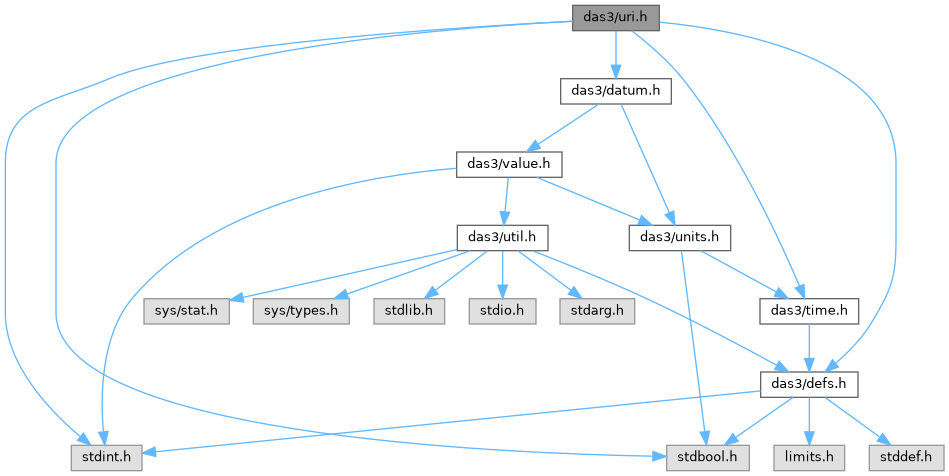
Go to the source code of this file.
Data Structures | |
| struct | DasUriField |
| One sub-field within a named coordinate type. More... | |
| struct | DasUriSegDef |
| Definition of one coordinate type for use by the URI template parser. More... | |
| struct | das_range |
| A constraint on one coordinate (or sub-field) used to select matching files. More... | |
Macros | |
| #define | DURI_MAX_PATH 2048 |
| Maximum length of a rendered URI / file path. | |
Enumerations | |
| enum | DasUriProto |
| Transport protocol, from the leading scheme of a URI template. | |
Functions | |
| DAS_API DasErrCode | das_range_fromUtc (das_range *pRng, const char *sBeg, const char *sEnd) |
| Initialize a das_range for the "time" coordinate from ISO-8601 UTC strings. | |
| DAS_API DasErrCode | das_range_fromTime (das_range *pRng, const das_time *tBeg, const das_time *tEnd) |
| Initialize a das_range for the "time" coordinate from das_time structs. | |
| DAS_API DasErrCode | das_range_fromInt (das_range *pRng, const char *sCoord, int64_t nBeg, int64_t nEnd) |
| Initialize a das_range for a named integer sub-field. | |
| DAS_API DasErrCode | das_range_fromDatum (das_range *pRng, const char *sCoord, const das_datum *dmBeg, const das_datum *dmEnd) |
| Initialize a das_range from pre-built das_datum values. | |
| DAS_API const DasUriSegDef * | das_time_uridef (void) |
| Return the built-in coordinate definition for the time coordinate. | |
| DAS_API char ** | das_uri_list (const char *sTemplate, const DasUriSegDef *pDef, int nRanges, const das_range *pRanges, size_t *pCount) |
| Collect every path a template and ranges yield into one heap array. | |
Finding files whose names encode coordinate values, via URI templates.
Archives commonly encode coordinate values (a date, an orbit number, a spacecraft clock count) in directory and file names. A URI template says where those values sit in a path so that, given a coordinate range, the matching files can be found by listing directories. Paths are never guessed: every directory that could hold a match is read.
$X short token, one character $(coord.field) qualified long token $(coord.field;mod=val) long token with modifiers shorthand, only for a coordinate with one field
Any DasUriField with a non-zero cShort gets a short token. A Voyager spacecraft clock registered with fields 'P' (partition), 'M' (mod64k) and 'S' (mod60) could be used as:
P$P/V1P$P_$x/C$M$S.DAT
The long form names the coordinate (DasUriSegDef.sCoord) and the field (DasUriField.sLong), the same dotted name that a das_range uses:
template: /data/$(time.year)/$(time.yday)/file_$(time.year)$(time.yday).dat range key: "time.year", "time.yday"
A token that names no registered coordinate or field is an error, never a silent wildcard. Short tokens take no modifiers, so the Autoplot form $(Y;pad=none) is not accepted.
Two variable-width fields may not sit side by side; put a literal between them or give one a fixed width.
The engine knows nothing about time. Register any DasUriSegDef with DasUriTplt_register() before calling DasUriTplt_pattern(). The library ships one, das_time_uridef(), which supplies $Y $m $d $j $H $M $S. A coordinate such as an orbit counter is one more definition; no mapping from orbit to time is assumed.
Field values are non-negative integers written in decimal digits.
$x Opaque wildcard. Of the files that match, the lexicographically last is used.
$v Version. Of the files that match, the greatest version is used, compared as the type= modifier says.
Neither is a coordinate. Files compete only when all their coordinate values agree, so a directory holding many days yields one file per day. In a directory name the token selects nothing: every matching directory is searched.
A path component may hold one $x or $v, and it must be followed by literal text or end the component.
pad=none The field is not zero padded and has variable width.
delta=N Accepted and preserved, but not yet used. A file is taken to cover one unit of the finest field in its path.
type=sep (default for $v) Split on '.' and compare each part as an integer, so 1.10.0 is later than 1.9.0.
type=int Compare as a single integer; for counters such as v01, v02.
type=alpha Compare as text, the same as $x.
Under type=sep and type=int two names can resolve to the same version, "v1" and "v01" for example. The lexicographically last is used and a warning is logged.
A template with no scheme, or with file://, names local files, and the paths returned carry no scheme. http:// and https:// are parsed but can not be iterated yet: init_DasUriIter() fails for them.
Autoplot's field codes are used wherever possible, so common templates read the same in both. The differences:
| DAS_API DasErrCode das_range_fromUtc | ( | das_range * | pRng, |
| const char * | sBeg, | ||
| const char * | sEnd | ||
| ) |
Initialize a das_range for the "time" coordinate from ISO-8601 UTC strings.
Any format das_datum_fromStr() takes works here: "2025-10-01", "2025-288", "2025-10-15T06:00".
| pRng | Storage to initialise; all fields are overwritten. |
| sBeg | Range begin (inclusive). |
| sEnd | Range end (exclusive). |
| DAS_API DasErrCode das_range_fromTime | ( | das_range * | pRng, |
| const das_time * | tBeg, | ||
| const das_time * | tEnd | ||
| ) |
Initialize a das_range for the "time" coordinate from das_time structs.
Normalization: Seconds keep full precision. year, month and mday are used and yday is recomputed. A leap second stays 60.x.
| pRng | Storage to initialise; all fields are overwritten. |
| tBeg | Inclusive range begin; copied. |
| tEnd | Exclusive range end; copied. |
| DAS_API DasErrCode das_range_fromInt | ( | das_range * | pRng, |
| const char * | sCoord, | ||
| int64_t | nBeg, | ||
| int64_t | nEnd | ||
| ) |
Initialize a das_range for a named integer sub-field.
| pRng | Storage to initialise; all fields are overwritten. |
| sCoord | Sub-field name, e.g. "sclk.mod64k". Stored lower-cased; must fit in 31 chars. |
| nBeg | Inclusive range begin. |
| nEnd | Exclusive range end. nBeg > nEnd is a rollover, see das_range. |
| DAS_API DasErrCode das_range_fromDatum | ( | das_range * | pRng, |
| const char * | sCoord, | ||
| const das_datum * | dmBeg, | ||
| const das_datum * | dmEnd | ||
| ) |
Initialize a das_range from pre-built das_datum values.
The datums are copied, so they must own their bytes: a datum that refers to outside memory is refused. Use vtTime for "time" and numeric datums for sub-fields.
| pRng | Storage to initialise; all fields are overwritten. |
| sCoord | Coordinate or sub-field name. Stored lower-cased. |
| dmBeg | Inclusive begin datum. |
| dmEnd | Exclusive end datum. |
| DAS_API const DasUriSegDef * das_time_uridef | ( | void | ) |
Return the built-in coordinate definition for the time coordinate.
short long name width range qualified token
$Y year 4 1678 - 2262 $(time.year) $m month 2 01 - 12 $(time.month) $d mday 2 01 - 31 $(time.mday) $j yday 3 001 - 366 $(time.yday) $H hour 2 00 - 23 $(time.hour) $M minute 2 00 - 59 $(time.minute) $S second 2 00 - 60 $(time.second)
The result is static: nothing to free, always valid.
| DAS_API char ** das_uri_list | ( | const char * | sTemplate, |
| const DasUriSegDef * | pDef, | ||
| int | nRanges, | ||
| const das_range * | pRanges, | ||
| size_t * | pCount | ||
| ) |
Collect every path a template and ranges yield into one heap array.
For callers that want the whole list up front. Use the iterator to handle files as they are found.
| sTemplate | URI template string, as for DasUriTplt_pattern(). |
| pDef | The one coordinate definition to register, or NULL for a template with only literals, $x and $v. Templates that need more than one must use the iterator. |
| nRanges | Number of entries in pRanges. |
| pRanges | Array of coordinate range constraints. |
| pCount | If not NULL, receives the number of paths. |
 1.9.8
1.9.8